Signed in as:
filler@godaddy.com

Living in an agricultural area means we have irrigated fields around us, and wherever water collects, mosquitoes can become a problem. Today we spotted a Common Green Darner in our yard, sometimes called a “mosquito hawk” because dragonflies are fierce predators of mosquitoes and other flying insects.
As beekeepers, we wondered whether having more dragonflies around might put our honeybees at risk. Dragonflies can occasionally catch and eat individual honeybees, but they do not attack hives or pose a significant threat to a healthy colony. A dragonfly is far more likely to be helping us with mosquitoes than harming our bees.
Now we're interested in making our yard more attractive to these fascinating aerial hunters. More dragonflies could mean fewer mosquitoes, while adding another interesting predator to the ecosystem around our garden and hives.

Our total was 30 pounds of honey from two Apimaye hives, working with a total of 11 frames. It was a productive extraction, and the frames yielded more than honey alone.
The process produced a surprisingly large amount of bee bread and propolis, collected along with the material scraped from the frames. We returned the bee bread to the hives so the bees could make use of it as a valuable source of stored nutrition.
There was considerably less usable beeswax than expected. Much of the wax was mixed with other hive materials, leaving relatively little clean wax to save for future projects.
Overall, the extraction gave us a good look at just how much goes into a hive beyond the honey itself. Each frame carried a mixture of food stores, wax, propolis, and the accumulated materials of a working colony. Every year is different.
It was time to extract honey today.
My husband used the smoker to calm the bees and make them more docile while he removed the honey-filled frames. Once the frames were brought in, he scraped the wax caps from the honey cells, exposing the honey underneath.
The uncapped frames were placed into our honey extractor, where the honey was spun from the comb. The extracted honey was then filtered before being stored.
We also saved the wax cappings. After filtering out the remaining honey, the wax will be used to make candles, giving us another useful product from the harvest.
Byproduct: Beeswax cappings for candles
Process: Smoke → remove frames → uncap → extract → filter → store
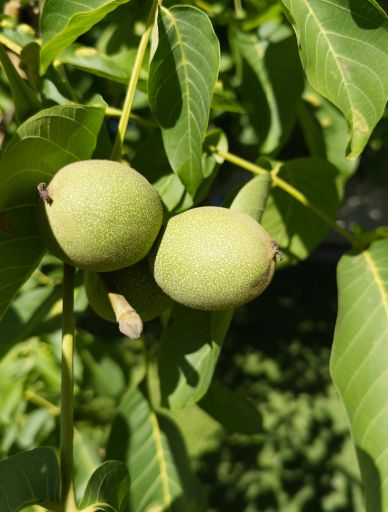
Our walnut tree is loaded this year, which means I am watching the developing nuts a little more closely than usual. One thing I am particularly watching for is walnut husk fly.
The adult flies lay their eggs in the green outer husks. When the larvae hatch, they tunnel through the husk, turning it black, soft, and messy. The nut inside is often still edible, but the damaged husks can be much harder to remove and may stain the shell. Trust me, processing walnuts after husk flies have invaded is a nasty job.
Because we raise honeybees, managing the flies presents another challenge. I want to protect the walnut crop, but protecting our pollinators is equally important. Any treatment has to be considered carefully so that I am not solving one problem while creating another.
For now, I am watching the tree closely and looking for signs of the flies while considering ways to manage them with as little risk to our bees as possible.
It is another reminder that managing a homestead often means balancing one part of the ecosystem with another.
Sometimes the best approach is to observe first and act carefully.
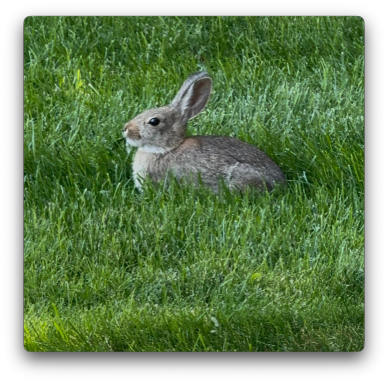
Our property is home to a healthy population of wild rabbits, and it is always a treat to see them grazing on the lawn in the early morning or evening. So far, they seem perfectly satisfied with the grass and have mostly ignored our garden beds, although I suspect that could change at any time.
We are also regularly visited by owls and hawks. I have watched hawks take doves from the property, so it is easy to imagine that rabbits could also become part of their diet, even though I have never witnessed it myself.
Watching the wildlife here has made me more aware of the natural relationships taking place around us. The rabbits, birds of prey, insects, plants, and garden are all part of the same ecosystem. Each species affects the others, sometimes in ways we notice and sometimes in ways we don't.
Living on the property gives me the opportunity to observe these relationships over time. What might seem like an ordinary morning in the yard can reveal another small piece of how the land works.
The more closely I observe, the more I realize that the property is not simply a place where we live. It is a living ecosystem of its own.
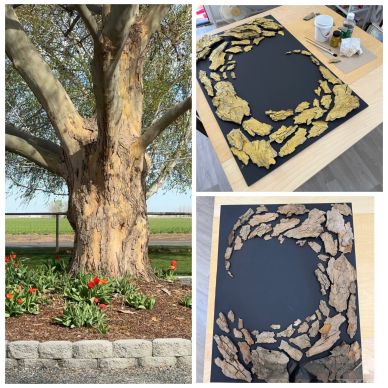
For years, I watched our sycamore tree shed its bark and thought of it as something to clean up and discard. Recently, though, I started wondering if there might be something I could do with it. The pieces were so interesting in shape, texture, and color that I began collecting them rather than throwing them away.
Not long after I started thinking about the possibilities, I saw another artist create a piece using bark. Seeing what someone else had done with this natural material gave me the inspiration to explore the idea further.
I washed and carefully prepared the pieces I had collected and decided to experiment with two approaches. In one, I left the bark completely natural, allowing its original color and texture to remain visible. In the other, I painted the bark gold.
The contrast between the two was fascinating. The natural bark had a quiet, organic quality, while the gold brought attention to the ridges, cracks, layers, and irregular edges. I realized that the texture itself was what made the bark so interesting to work with.
This experiment reminded me how easily we can overlook the materials that surround us every day. I had walked past that sycamore tree countless times, watching it shed its bark, without ever really seeing the bark as anything more than something to clean up.
Now, I see it differently. What I once discarded has become a natural material worth collecting, studying, and turning into art.
Sometimes the materials for your next piece are already around you. You simply have to start looking at them differently.

A pretty little mourning dove has taken over an old nest right outside my studio, and I check on her every day. Having her so close has given me the chance to watch her quietly go about the business of raising her young.
This year, I noticed something I had never observed before. The same nest was used twice. In previous years, I had watched a nest be used once and then abandoned. This time, a mourning dove returned to an existing nest and used it again for another brood.
That caught my attention and led me to learn more about mourning dove nesting habits. Their nests are notoriously loose and flimsy, often looking more like a casual arrangement of twigs than a carefully constructed nest. They may use an existing nest rather than building a new one, which certainly seems to have been the case with this little dove.
Mourning doves usually lay two eggs, with both parents taking turns incubating them for about two weeks. After the chicks hatch, the parents feed them a remarkable substance called crop milk before gradually introducing seeds. They can raise several broods during a breeding season, which helps explain why they are such a familiar presence around our property.
For now, I am enjoying the opportunity to watch this little family develop from just outside my studio. It is a small reminder that while I am focused on creating inside the studio, there is an entire world of activity happening just outside the door.
Sometimes watching closely reveals that even the ordinary things around us have something new to teach us.
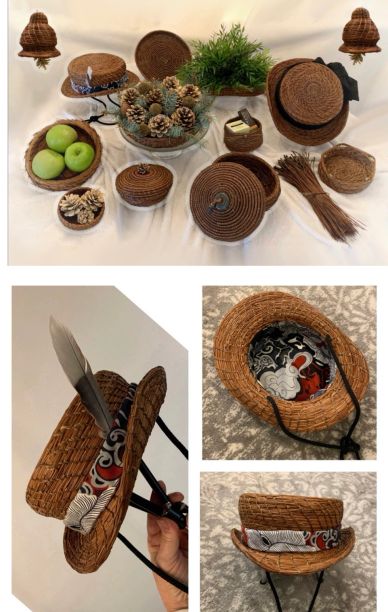
During lockdown, I spent much more time walking around our property and noticing the small details of the natural world around me. One day, I looked beneath our Scottish pine trees and noticed the abundance of pine needles scattered across the ground. There were so many of them that I began wondering, "What could I make with all of these?"
That curiosity led me to discover the art of pine needle weaving. I learned that the needles could be preserved and softened by soaking them in vegetable glycerin, making them more flexible for weaving. I also learned to use artificial waxed deer sinew to bind the bundles of needles together as I worked.
The process turned out to be more complicated than I expected. Not every pine needle responded to the glycerin treatment in the same way. I discovered that the age and condition of the needles, how long they had been on the ground, their moisture level, the way they had been stored, and even the particular characteristics of the needles could affect the results. Needles that had already been damaged by insects or weather could become speckled, soft, or degraded, and some simply would not soften properly.
I used the pine needles to make baskets and hats. What began as an experiment with something I had found scattered beneath our trees became something tangible that could be shared with others. The hats have been taken to school for show and tell, giving children the opportunity to see how a natural material from someone's own property can be transformed into something completely different.
What began as a simple question about an abundance of fallen pine needles turned into an entirely new creative process. Instead of seeing them as something to rake away, I began seeing them as a natural material with its own possibilities and limitations.
The experience also changed the way I look at the ground beneath our trees. There is an abundance of useful material lying there, waiting to be noticed.
Sometimes the materials for making something new are already beneath your feet.

Our homestead sits between several large, flat agricultural fields where irrigation waterers run throughout the growing season. With more than 20 trees, gardens, and small pockets of habitat on our property, I have been surprised by how many different birds make their way here.
The surrounding fields provide open areas for feeding, while the irrigation water attracts birds from the surrounding landscape. Our trees offer shelter, nesting sites, and places to rest. Together, these small features seem to create an inviting little refuge in the middle of the surrounding farmland.
Over the years, I have watched an impressive variety of birds come and go. Some are familiar visitors that I see regularly, while others appear only occasionally. Among them are white barn owls, great horned owls, mourning doves, robins, swallows, finches, goldfinches, magpies, hummingbirds, killdeer, ducks, geese, crows, blackbirds, starlings, pheasants, quail, hawks, eagles, woodpeckers, ravens, and western kingbirds.
Seeing such a variety of wildlife on a relatively small piece of land has made me pay closer attention to what our property provides. The trees, gardens, water, and even the surrounding agricultural fields all contribute something.
I used to think of our property simply as our home and garden. Watching the birds has changed that perspective. It is also a small piece of habitat within a much larger landscape, and the wildlife seems to know exactly how to make use of it.
Even a small piece of land can become an important part of the larger ecosystem when there is something there to attract and shelter wildlife.

We have a small stand of bamboo on our property, and I became curious about how I could use this fast growing plant in a creative way. That curiosity led me to experiment with making my own bamboo paper.
I expected the process to be complicated, but I was surprised by how simple it actually was. I started by chopping the bamboo into small pieces and cooking it in water with washing soda until the fibers softened and separated. After thoroughly rinsing the fibers, I blended them with plenty of water until they became pulp.
From there, I mixed the pulp into a vat of water and used a mould and deckle to lift individual sheets. The sheets were pressed and dried, gradually becoming handmade paper with the natural fibers and texture of the bamboo still visible.
There was something satisfying about watching the transformation. A plant growing in our own landscape became loose fibers, then pulp, and finally sheets of paper that I could use as an artistic material.
Once I had the paper, I began thinking about what I could create with it. I used the handmade bamboo paper to make a lantern and a mask, allowing the natural texture and visible fibers to become part of the finished pieces.
The process gave me a new appreciation for bamboo as a creative material. I had always thought of it primarily as a fast growing plant, but experimenting with it revealed another possibility. Something growing in our own landscape could become paper, and that paper could become art.
Sometimes the most rewarding part of creating is discovering what an ordinary material can become.

Beekeeping has become an ongoing process of learning, observing, and recording. Throughout the season, we keep notes about hive inspections, queen activity, brood patterns, honey production, feeding, pest management, and the many changes we see within our colonies.
Our beekeeping journal helps us keep track of what we observe, what we do, and what each hive may need next. Looking back through those records also reminds me how much I have learned through hands on experience.
I have learned how to safely transport bees and care for them from the moment they arrive until they are settled into their new hive. I have learned how to inspect a colony, recognize changes in brood patterns, monitor the queen, and watch for pests and other problems.
Harvesting honey has brought another set of skills. I learned how to use an extractor to remove honey from the frames and how to process the wax left behind. Separating and clarifying the wax turned out to be another interesting part of the process, and I eventually used that wax to make candles.
The more I work with the bees, the more I realize how many different skills are connected to keeping a hive. Beekeeping has become part science, part observation, part practical work, and part creative exploration.
Many of these real experiences have also found their way into Milo's Hidden Worlds. The story draws from what I have learned while working with our own bees and turns those experiences into adventures that introduce children to the fascinating world inside a hive.
The more closely I observe the bees, the more they teach me about the world around them and what I can create from what they leave behind.

Honey extraction is one of our favorite homestead traditions. We usually harvest once or twice a year, depending on the bees, the weather, and the season. Each harvest is a little different, and there is always something interesting to notice.
One of the things I have come to appreciate is the remarkable variety of honey colors. Honey can range from nearly clear and pale golden to rich, deep amber. The color is influenced by the flowers our bees visit, which means each harvest gives us a small glimpse into what was blooming around our hives.
I enjoy knowing that the honey in each jar has a connection to the landscape surrounding us. The bees have traveled from flower to flower, gathering nectar from the plants available to them at that particular time of year. In that sense, every harvest tells a slightly different story about the season.
We also try to make use of what the bees provide beyond the honey. The wax left behind after harvesting is separated and clarified, then turned into beeswax candles. What began as part of the hive becomes something useful and beautiful in our home.
At Christmas, we enjoy sharing these pieces of our homestead with family and friends. Jars of our honey, fresh walnuts from our trees, and handmade beeswax candles become simple gifts that represent the work of our bees, our land, and our own hands.
Every harvest carries a record of the season in which it was made.